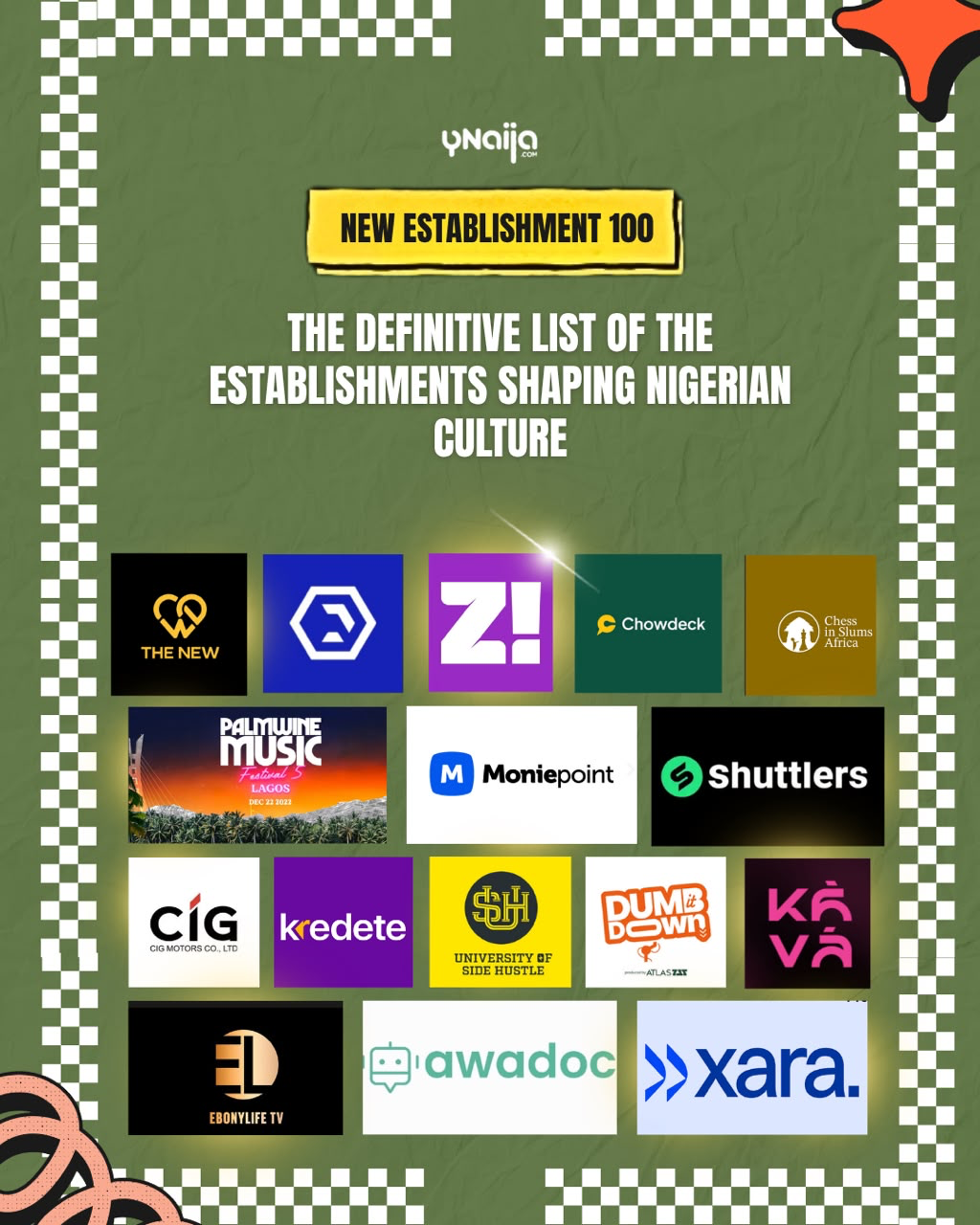


The people, companies, and moments that built something in Nigerian culture, January 2025 to September 2026.
1. AwaDoc
AwaDoc is a WhatsApp-based AI health assistant co-founded by medical doctor and health communicator Chinonso Fidelis Egemba, popularly known as Aproko Doctor. What began as an idea in December 2024 launched in April 2025, turning Aproko Doctor’s years of health education and digital community-building into a technology platform that makes reliable health information more accessible. Since launch, AwaDoc has served more than 100,000 users across 20 countries, exchanged over 1.1 million messages, and raised a $500,000 pre-seed round at a $2.5 million valuation. Its emergence signals a new direction for health communication in Nigeria, where trusted digital education is being combined with AI to meet people where they already communicate: WhatsApp.
2. EbonyLife ON Plus and EbonyLife Place London
EbonyLife ON Plus is the global streaming platform launched by Mo Abudu for pan-African series, films, talk shows, and lifestyle content, and EbonyLife Place London is the cinema, restaurant, and members’ complex that her company opened in the United Kingdom in the fourth quarter of 2025. Together, they represent the most ambitious infrastructure play by any Nigerian media owner in this cycle: an owned distribution channel and a physical foothold in a major Western market, built precisely as global platforms were reducing their commitments in Africa. Abudu has spent a decade licensing African stories to other people’s platforms and learning the limits of that arrangement. The establishment is the logical conclusion: owning the pipe and the content, so that African stories reach global audiences without requiring anyone else’s permission.
3. Delicious or Disaster
Delicious or Disaster is the competition cooking show created, executive-produced, and hosted by Tolani Tayo-Osikoya, known as Chef T, which premiered on 24 September 2025 on her Diary of a Kitchen Lover channel and has since run for a third season. Four chefs compete each episode against impossible ingredient pairings, brutal time limits and kitchen twists designed to break their composure, judged by figures including Opeyemi Famakin and Asherkine, with ₦500,000 at stake per episode. Chef T built the show herself rather than pitching it to a broadcaster, moving from creator to executive producer of an original format. The establishment’s significance lies in that independence: a Nigerian creator financing and producing competitive television for her own platform, at a standard that would previously have required a network.
4. The largest painting on canvas
In April 2025, Kanyeyachukwu Tagbo Okeke, a fifteen-year-old Nigerian artist with autism, completed a painting larger than a football field, setting the Guinness World Record for the largest painting on canvas, an achievement acknowledged by the president. The work was conceived as an autism awareness project, built around the idea that what cannot be said can be painted, and executed at a scale that made the point impossible to overlook. Conversations about autism in Nigeria still run heavily through stigma and silence, with families often managing diagnosis privately and public understanding lagging far behind. The establishment’s significance lies in how thoroughly the record inverted that dynamic, placing an autistic Nigerian teenager at the centre of a global story told through his own work rather than through anyone else’s advocacy.
5. Afropolitan
Afropolitan is a digital community and cultural network built around the idea of creating a borderless African nation for the global African diaspora. Founded by Eche Emole and Chika Uwazie, the project began as an events and community organisation and grew during the pandemic into a digital network with tens of thousands of members and a digital passport. In 2025 and 2026, its podcast became one of its most visible cultural instruments, bringing conversations with people building modern Africa to a global audience. From fintech and entrepreneurship to music, media and the creative economy, Afropolitan is creating a space where Africans and the diaspora can participate in a shared conversation about the continent’s future.
6. Flames Of A Wildfire
Flames Of A Wildfire is Greatman Takit’s 23-track gospel album and one of the major Afrogospel projects of 2026. Released on 26 July, the project features artists including Nathaniel Bassey, Anendlessocean, Lawrence Oyor, Prinx Emmanuel, TY Bello, Limoblaze and Oba Reengy. Its rollout included listening parties in Lagos, Abuja and Port Harcourt, extending the project beyond music into a live cultural and faith experience. The album represents the continued evolution of Afrogospel, where worship, Afrobeats, hip-hop and contemporary pop culture increasingly occupy the same space.
7. Item 7 Go
Item 7 Go opened in Lagos in April 2025 as a takeout-focused restaurant built around a simple proposition: familiar Nigerian food, generous portions, and prices that remain accessible in an increasingly expensive food market. Its Allen Avenue location quickly became a social media talking point, with customers drawn to its straightforward menu of rice, chicken, beef, fish, plantain, and shawarma, while delivery platforms helped push the brand beyond its physical location. By 2026, Item 7Go had begun expanding its footprint beyond Lagos, reflecting the growing appetite for affordable, distinctly Nigerian quick-service food. Its significance lies less in fine dining than in understanding a very current Nigerian consumer: young, digitally connected, price-conscious, and still deeply attached to everyday Nigerian meals.
8. Montana Media / UchemontanaTV
Montana Media is Uche Montana’s production outfit, while UchemontanaTV represents her move towards building a direct relationship with her audience outside traditional Nollywood structures. After establishing herself as an actor through projects including Hush and Thin Line, Uche Montana has increasingly moved into creating and owning her own content ecosystem. The platform reflects a broader shift in Nollywood, where actors are no longer only performers within other people’s productions but are building their own channels, audiences and intellectual property. Its development comes at a time when YouTube and other direct-to-audience platforms are changing how Nigerian entertainment is produced, distributed and monetised.
9. MasterChef Nigeria
MasterChef Nigeria is the first Nigerian edition of the global cooking competition format, which launched a nationwide search for the country’s best home cook in February 2026 and premiered in April with ten contestants competing for a ₦73 million grand prize, the largest in the franchise’s African history. The format had run in South Africa, Ghana and across Asia for years while Nigeria, whose food is among the continent’s most widely exported culturally, had no equivalent competitive platform. The season treated Nigerian home cooking as technically demanding rather than sentimental, judging it by the same standards it applies elsewhere. The establishment’s significance lies in that framing, and in creating a structure through which Nigerian cooks can be credentialed nationally rather than through informal reputation alone.
10. FOLA – Ten nominations at the 2026 Headies
FOLA led the 18th Headies with ten nominations, the largest haul of the year, spanning Best Male Artiste, Album of the Year for Catharsis, Best R&B Album, Best Recording of the Year, Songwriter of the Year, Afrobeats Single of the Year, Digital Artiste of the Year and Next Rated. It was his first appearance on a Headies ballot at all, which is the detail that matters: an artist arriving not with a single breakout record but with an album complete enough to be recognised across writing, performance, production and commercial categories at once. In a year dominated by established names, the establishment represents the clearest evidence that Nigerian R&B has produced a new artist capable of competing for the industry’s central prizes rather than its specialist ones.
11. Kava
Kava is a Nollywood-first streaming platform, built as a joint venture between Inkblot Studios and Filmhouse Group and led by co-CEOs Kene Okwuosa and Chinaza Onuzo. It launched in August 2025, at the exact moment Netflix and Prime Video were scaling back their African commissioning, opening with more than 30 premium Nollywood titles on a weekly release schedule, backed by VestedWorld and TLG Capital, before extending into the UK. Where earlier platforms tried to serve everyone, Kava is deliberately narrow: Nigerian film first, the rest of the continent after. By September 2026, it had moved from licensing other people’s films to commissioning its own, beginning with A Mama Deola Wedding Story as its first African Original. Its significance lies in ownership; an attempt to keep the economics of Nollywood distribution in Nigerian hands rather than leaving them to platforms that can withdraw at will.
12. Director Pink
Director Pink has become the most visible woman working in Afrobeats music video direction, a field that has produced global visual languages while remaining almost entirely male behind the camera. In June 2026, CNN profiled her as one of the filmmakers shaping how Afrobeats looks, and she is nominated for Music Video of the Year at the 18th Headies, the only woman in a category otherwise filled by the industry’s established names. Her work includes the video honouring Mohbad, a piece that had to hold real public grief rather than sell a record. The establishment’s significance lies in the position itself: a woman directing at the top of a discipline that determines how Nigerian artists are seen globally, and doing it visibly enough that the next one will not be treated as an anomaly.
13. Nouvelle Films
Nouvelle Films is a Nigerian production company that has grown into one of the major engines of the country’s music video industry. Built by producer Femi Dapson, the company has produced visuals for artists including Burna Boy, Rema, Kizz Daniel, Omah Lay, and Buju. Across 2025 and 2026, Nouvelle Films demonstrated the scale of Nigeria’s evolving music-video economy, producing projects such as Burna Boy’s “Update” and Rema’s “Kelebu”, with some productions reportedly carrying budgets of up to ₦246 million and crews of around 200 people. Beyond production, the company has also partnered with PEFTI Film Institute on an intensive workshop to train emerging producers, positioning itself not only as a production house but also as part of the infrastructure developing the next generation of Nigeria’s visual industry.
14. The Alakada franchise
The Alakada franchise is the comedy property Toyin Abraham has built and owns through her production work, following a character whose social climbing and invention have carried multiple films across more than a decade. In this cycle, Alakada: Bad and Boujee approached ₦500 million at the box office, while the YouTube spin-off Alákadá Gen Z 3 gathered 4.4 million views in April alone, giving the franchise two distribution lives at once. Abraham then directed Oversabi Aunty, which grossed ₦1.017 billion, becoming the first Nollywood directorial debut to pass a billion naira and earning her the National Film and Video Censors Board’s Box Office Champion Award. The establishment demonstrates what franchise ownership makes possible in Nollywood: a character that can be released theatrically, online and repeatedly.
15. AFCON 2025: the assists and the penalty
Ademola Lookman finished the 2025 Africa Cup of Nations as the tournament’s leading provider with four assists, driving a Nigerian attack that scored fourteen goals, the highest total of the competition, and was named to the Team of the Tournament. In the bronze medal match against Egypt in Casablanca in January 2026, after Nigeria had been held goalless through regulation time, he scored the decisive penalty in the shootout to secure third place. Lookman’s route to that moment ran through years of being overlooked in England before choosing Nigeria, and the tournament settled any remaining question about where his best football belongs. The establishment is a body of work rather than a single moment: the most complete individual campaign by a Nigerian player at an AFCON in years.
16. MENtality with Ebuka
MENtality with Ebuka is a podcast and conversation platform created by broadcaster Ebuka Obi-Uchendu in partnership with Banky W. Launched in Lagos in October 2025, the platform moves beyond the traditional entertainment interview format to examine Nigerian masculinity through conversations about fatherhood, money, mental health, relationships, and the pressures men often struggle to articulate publicly. Its significance lies in creating a mainstream space for conversations about Nigerian men that are often kept private. Coming from one of the country’s most recognisable television personalities, the platform also demonstrates how established media figures are increasingly creating owned formats and communities outside traditional broadcast television.
17. Guilty as Charged
Guilty as Charged is the self-produced world tour through which comedian Bovi Ugboma took Nigerian stand-up to international audiences across 2026, selling out dates in the United Kingdom and Canada before closing the run with homecoming shows in Benin City and Lagos. The tour is the establishment rather than the joke: routing, venue selection, ticketing, and production are handled as a business he controls, rather than appearing as a guest on bills assembled by promoters. Nigerian comedy exports have usually travelled through diaspora event organisers, who own the relationship with the audience. Bovi’s significance in this cycle is in owning that relationship directly, demonstrating that a Nigerian comedian can build an international touring circuit as a standing asset rather than a series of one-off appearances.
18. Meta Creators of Tomorrow
Rodney Umeh, who creates as The Wisdom Man, was selected for Meta’s Creators of Tomorrow campaign in Nigeria and named among the country’s seven biggest TikTok creators of 2026, built on comedy drawn from everyday Nigerian experience and delivered as accumulated wisdom. His material works because it is observational rather than performed, finding its humour in the logic Nigerians apply to ordinary situations. Content creation was never the plan; he has spoken about arriving at it sideways, which is the route most of Nigeria’s creator economy has taken. The establishment’s significance lies in the platform recognition itself: Meta and TikTok both treating Nigerian creators as a category worth naming and investing in, and Umeh appearing on both lists in the same cycle.
19. Afrobeats Intelligence
Afrobeats Intelligence is a music journalism and cultural documentation platform founded by Joey Akan. It began as a newsletter during the pandemic and later evolved into a podcast known for unusually candid conversations with artists and industry figures. In February 2026, the franchise returned for its fifth season under OkayAfrica in partnership with Martell, featuring guests including Shallipopi, Wale, Sarz, Ladipoe, Kcee, and BOJ. With more than a million downloads behind it, Afrobeats Intelligence has become more than an interview series: it is an archive of the people, ideas and business shaping contemporary African music, providing context for an industry that is increasingly influential globally.
20. Dumb It Down: The Clarity Lab
Dumb It Down: The Clarity Lab is the explanatory interview series launched by Atlas 777 Media in August 2026 and hosted by Abimbola Craig, which invites specialist guests to make their expertise legible to everyone else. Craig built her profile as an actor and producer through Ndani TV, where Nigerian web series found their first sustained audience, and the show marks her return to screen in a format built around clarity rather than celebrity. Nigerian talk television has largely split between celebrity interviews and news panels, with little room for conversations that explain. The establishment sits in that gap, and marks Atlas 777’s entry into long-form video at a moment when Nigerian business media is still underserved by anything watchable.
21. A Mama Deola Wedding Story
A Mama Deola Wedding Story is the feature-film expansion of Folagade Banks’ hugely popular Mama Deola character. Produced and headlined by Folagade Banks and directed by Femi Adebayo, the film turns a social-media-born character into a studio-backed entertainment property. With King Sunny Adé’s involvement and Kava commissioning the project as its first African Original, the film represents an important crossover between Nigeria’s creator economy and formal film production. Its September 2026 premiere demonstrates how characters developed through social media can evolve into commercially viable intellectual property capable of carrying a feature-length story.
22. Crea8torium
Crea8torium is a creator-education platform and community co-founded by Salem King and Adaora Lumina Mbelu to build a more structured ecosystem for African creators. Launched in 2025, it combines education, interviews, community and live experiences, with watch parties in Lagos and Abuja and a growing community of more than 30,000 people. Its plans extend to creator playbooks, courses, industry data, an annual summit, and events across Nairobi, Accra, Johannesburg, and Cairo. At a time when Nigeria’s creator economy is expanding rapidly, Crea8torium is attempting to move the industry beyond individual virality by building the knowledge, community and infrastructure creators need to turn creative work into sustainable careers.
23. The Nigerian 100-meter record
Kanyinsola Ajayi broke the Nigerian 100 metres record in 2026 with 9.84 seconds, then matched it twice more in the same season, including a Diamond League victory in London against the strongest field he had faced. Nigerian sprinting has spent a decade defined by its women, with the men’s events drifting well behind continental rivals and national records standing untouched for years. Ajayi’s season was the clearest break in that pattern, delivered not as a single wind-assisted flash but as repeated performances at the same level across different meets and conditions. The establishment is the consistency as much as the time: a Nigerian man running sub-9.9 reliably enough to be treated as a contender rather than an outsider at global championships.
24. Giran Republic
Giran Republic is the record label Asake founded and through which he released his fourth album, distributed in partnership with Empire. M$NEY arrived on 1 May 2026 as the imprint’s first major release, with features from DJ Snake, Tiakola and Kabza de Small, and immediately broke the Nigerian first-week streaming record on Spotify with 42.2 million streams, passing the mark Wizkid had held. It went to number one on Nigeria’s TurnTable chart, number two on Billboard’s World Albums chart and charted in the United Kingdom and on the US independent albums list. Asake built his career inside YBNL, one of the most successful label systems in Nigerian music. The establishment’s significance lies in the departure: an artist at the peak of his commercial power choosing to own the structure around his work and outperforming the machinery he left behind.
25. HumAngle
HumAngle is the conflict and humanitarian reporting newsroom founded by Ahmad Salkida, covering insurgency, displacement, and systemic failure across Nigeria, the Sahel, and the Lake Chad basin. It marked six years in March 2025 with close to 40 staff across the newsroom and the HumAngle Foundation, and in October 2025 won the illicit financial flows category at the West Africa Media Excellence Awards for an investigation into the internet fundraising behind IPOB’s armed struggle, with its reporter Kunle Adebajo also named West Africa Journalist of the Year from a field of 793 entries. The establishment’s significance lies in its method: deep investigation combined with data journalism, GIS mapping, and a virtual reality documentary, applied to a conflict that most Nigerian media cover only in terms of casualty figures.
26. KFMD
KFMD is the imprint Qing Madi launched in 2026 after leaving JTon Music, the label that signed her as a teenager and released her debut album I Am The Blueprint. Her exit was followed by a breach-of-contract suit from her former label, with damages reported to be between $1 and $2 million, and she continued releasing through her own imprint, putting out the Barely Legal EP while the dispute was ongoing. Nigerian music has a long history of young artists signing early deals they later cannot leave, and most such disputes end with the artist silenced for years. The establishment’s significance lies in the refusal to go quiet: a young woman building the structure to own her masters and keep releasing while the legal argument about her past continues.
27. Yokuro Skincare
Yokuro Skincare is the clinical African skincare brand founded by Dr Adetola Adegoke, a British Nigerian medical doctor who practised in the United Kingdom for over a decade, and launched in Lagos on 18 July 2026. The range is built around a three-step principle of remove, replenish and reinforce, with formulations centred on kojic acid, liquorice root, cucumber, allantoin and green tea, and it launched through the Yokuro World Experience at Soto Gallery, an interactive ingredient lab with consultations conducted by the founder herself. Nigeria’s skincare market is saturated with imported products and unregulated lightening creams sold on promises rather than formulation. The establishment’s significance lies in the clinical framing: a doctor-led brand built for African skin, sold on what is in the bottle and why.
28. Rubels & Angels Food Court
Rubels & Angels Food Court entered a new phase of expansion in 2025 with the opening of its Festac location, taking its food-court model beyond its established Surulere and Akoka locations. The Lagos-based establishment offers a broad mix of Nigerian meals, fast food, breakfast options, small chops, platters, desserts and drinks, alongside dine-in, takeaway, delivery and catering services. Its 2025 expansion was accompanied by significant recruitment across restaurant management, operations, customer service, kitchen, pastry and logistics roles, reflecting a business scaling its physical and operational footprint. By 2026, Rubels & Angels had continued to operate as a multi-location food destination, with its offering spanning everyday meals and larger food experiences. In a city where food businesses increasingly compete on convenience, variety, and experience, Rubels & Angels is building a model that brings all three under one roof.
29. Moment by Mainstack
Moment is the creator convergence built by Mainstack, the Techstars-backed Nigerian creator commerce company, and staged in Lagos as what its organisers describe as Africa’s largest gathering of creators. Its 2026 edition programmed figures including M.I. Abaga, Salem King, and Fisayo Fosudo, and introduced the Moment Awards, positioned as the Grammys for African creators. The conference arrived at a moment of open commercial rivalry in the sector, with Mainstack and Selar trading billboards across Lagos in a public contest for creator loyalty. The establishment’s significance lies in what that rivalry signals: the Nigerian creator economy has passed the point of being a loose collection of individuals and now has competing platforms, an awards season and an annual industry gathering, which is what a sector looks like when it becomes an industry.
30. Coach of the Year
Justine Madugu was named Coach of the Year at the 2026 Nigeria Pitch Awards for his work with the Super Falcons, recognition that arrived in the same ceremony as honours for Victor Osimhen, Stanley Nwabali, Calvin Bassey and Alex Iwobi. Nigerian women’s football has generated far more silverware than the men’s game yet receives a fraction of the investment, attention, and coaching infrastructure, and its managers rarely feature in national conversations about the sport at all. The establishment’s significance lies partly in the award and partly in where it was given, placing the Super Falcons’ coach inside the country’s headline football ceremony rather than in a separate women’s category. Madugu’s standing reflects a squad that continues to compete continentally under conditions the men’s setup would not accept.
31. YarnGPT
YarnGPT is the text-to-speech model built by Saheed Azeez to speak Nigerian English, Yoruba, Hausa and Igbo in native accents, and in June 2026 it was acquired by Bluechip Technologies. Global voice systems mangle Nigerian names, flatten tonal languages, and produce output that Nigerian listeners instantly recognise as foreign, quietly limiting where voice technology can be deployed across the country’s banking, health, and education services. YarnGPT was built as a direct correction, released openly enough to be adopted and tested by other developers. The establishment’s significance lies in the exit as much as the model: a Nigerian language AI project acquired by a Nigerian enterprise technology company rather than absorbed abroad, keeping both the technology and its commercial
32. University of Side Hustle
University of Side Hustle is the feature film marking Darey Art Alade’s directorial debut, made for Livespot Studios and co-directed with Kayode Kasum, announced in August 2026. Darey has spent two decades as a recording artist, television host and, through Livespot360, one of the architects of Nigeria’s live entertainment business. Moving behind the camera extends that arc into film, and doing so within his own company’s studio arm means the project sits within an operation he helped build rather than on someone else’s development slate. Nigerian entertainment figures often diversify horizontally into unrelated businesses. The establishment is notable for going deeper instead, adding production capability to a company already holding events, talent and audience, and for a debut director choosing to learn the job alongside one of Nollywood’s most prolific commercial filmmakers.
33. Xara
Xara is the conversational banking assistant founded by Sulaiman Adewale that lets users move money, check balances, and manage accounts by messaging in Pidgin and Nigerian English on WhatsApp rather than navigating a banking app. Within ten months, it had processed ₦8 billion in transactions for 45,000 users, and has since integrated crypto deposits through Solana. Nigerian banking interfaces are built in formal English for users assumed to be comfortable with app menus, thereby excluding a substantial share of the market that transacts daily but does not read or type in that way. The establishment’s significance lies in the language decision: building financial infrastructure around how Nigerians actually communicate, rather than requiring them to adapt to the register the banks prefer.
34. AFCON 2025 Team of the Tournament
Victor Osimhen was named to the Team of the Tournament at the 2025 Africa Cup of Nations after scoring four goals and carrying Nigeria to the semi-finals and a bronze medal finish, before being crowned King of the Pitch and Best Striker at the 2026 Nigeria Pitch Awards. His tournament was defined by more than the goals: the speed, physicality and aggressive pressing that made defenders uncomfortable for ninety minutes and dragged an inconsistent Nigerian side into contention. Osimhen’s account of his journey to this point, published in this cycle, is a story of extreme scarcity in Lagos that became the most valuable African striker of his generation. The establishment is the campaign itself, and what it confirmed about where he now sits in the continental hierarchy.
35. Trashcoin
Trashcoin is a Nigerian waste-to-value platform that pays households and small businesses for the rubbish they would otherwise throw away, converting recyclable material into wallet value through a digital collection network. Founded by Chinenye Nlemchi, the company raised fresh funding in April 2026 to expand its collection infrastructure and rewards system. Its premise inverts how waste is treated in Nigerian cities: rather than a municipal problem to be managed, plastic and other recyclables become a consumer product with a price attached. Trashcoin belongs to a wider shift in which climate infrastructure is being built for ordinary households rather than corporations or donors, and in which environmental behaviour is being driven by direct economic incentives. In a country where formal waste collection reaches only a fraction of the population, the establishment represents an attempt to build the system from the household upward.
36. Commonwealth 400 metres gold
Samuel Ogazi became the first Nigerian man to win the 400 metres at a Commonwealth Games, taking gold in Glasgow in 44.25 seconds. He had already run 43.38 that season to set an NCAA record, a time that placed him fourth on the world all-time list over the distance and made him the fastest Nigerian ever to run the event. The one-lap sprint is among the most historically significant events in African athletics, and Nigeria had never won it at this level despite a long tradition of quarter-milers. The establishment’s significance lies in the margin between the Commonwealth performance and the NCAA run: Ogazi’s best is faster than almost anyone in history, which places him in genuine contention at the next Olympic and world championship cycle.
37. Love and New Notes
Love and New Notes is the Kayode Kasum film that took the biggest opening weekend of the 2026 Nigerian box office, grossing ₦106.5 million in three days and ending Behind the Scenes’ ten-week run at number one. Led by Timini Egbuson, the film moves between horror, romance, drama, heist and comedy, a deliberately unclassifiable mix that worked commercially at a moment when Nollywood’s biggest releases had settled into recognisable formulas. Kasum is among the most prolific commercial directors of his generation, with Ajosepo: The Gathering and Starlomo also released in this cycle. The establishment’s significance lies in the box office itself: evidence that Nigerian audiences will turn out in volume for an original idea, not only for franchise comedy and historical epics.
38. Decide
Decide is an artificial intelligence agent that builds, audits and analyses spreadsheets from plain-language instructions, founded by Abiodun Adetona. In February 2026, it ranked fourth in the world on SpreadsheetBench, the industry benchmark for spreadsheet-capable AI systems, placing a Nigerian product among the leading global tools in its category, and it passed 3,000 users within weeks of launch. Its significance lies less in the product itself than in where it was built and against whom it competes. Nigerian software has historically been positioned as local infrastructure solving local problems; Decide was measured against the same leaderboard as products from far better-funded laboratories and held its position. The establishment reflects a growing confidence within Nigeria’s technical community that global benchmarks, rather than domestic market share alone, are a fair measure of the work being produced here.
39. Nigerian food on MasterChef Australia
Olaolu Olorunnimbe carried Nigerian cooking into the top 24 of MasterChef Australia’s 2026 season, arriving on the competition’s largest stage with ofada stew and the techniques behind it, and winning a $10,000 challenge along the way with a dish honouring his father’s favourite. Nigerian food has global recognition as street and home cooking, but almost no presence in the televised competitive formats that shape how the world categorises a cuisine as serious. Olorunnimbe’s run placed Nigerian flavour, method, and vocabulary before an audience that had never encountered them in that setting, judged by the same standards as French or Japanese technique. The establishment’s significance lies in that framing, and in a Nigerian in the diaspora choosing to compete as himself rather than adapting to the palate in the room.
40. Palmwine Music Festival
Palmwine Music Festival is the live-music franchise built by Show Dem Camp, the rap duo of Tec and Ghost, around the palmwine sound they developed across their long-running project series. What began as a Lagos concert has grown into a touring cultural property: in the period under review, the festival staged a Lagos edition in December 2025 that drew surprise appearances from Tems and Odumodublvck, and took the brand to SummerStage in New York’s Central Park. Few Nigerian live-music brands have successfully exported themselves rather than simply sending artists abroad, and fewer still have done so while retaining their original identity. The festival demonstrates that a Nigerian music format can hold its own on the international stage, with its own name, aesthetic, and audience, rather than being absorbed into someone else’s programming.
41. Call of My Life
Call of My Life is the feature directing debut of Dammy Twitch, which became the highest-grossing Nollywood film of 2026 so far with ₦498 million, led by Uzoamaka Power alongside Zubby Michael. A romantic comedy carrying that number in a year of epics and star vehicles is unusual, and doing it as a first feature is more unusual still. Nigerian cinema’s commercial top tier has been occupied for years by the same handful of established producer-directors, with new entrants finding it difficult to secure the screen space and marketing muscle that turn a good film into a hit. The establishment matters because it demonstrates that the ceiling is reachable from outside that circle, and that audiences will follow a film rather than a name when the work connects.
42. Omoni Oboli TV
Omoni Oboli TV is the YouTube studio through which actor and filmmaker Omoni Oboli releases feature films directly to audiences, bypassing cinemas and streaming platforms entirely. In December 2025, the channel was named YouTube’s Top Creator Channel in Nigeria for the year, with more than 1.8 million subscribers, after Love In Every Word surpassed 32 million views, becoming the most-watched Nollywood film on the platform. The operation runs on a weekly release rhythm that keeps crews continuously employed, a point Oboli has made repeatedly in defending the model. Its significance is structural: as cinema windows narrowed and global streamers scaled back their African commissioning, YouTube became a genuine distribution route for Nigerian film rather than a secondary dumping ground, and Omoni Oboli TV is the clearest proof that the economics of that route can work.
43. Laju Iren Films
Laju Iren Films is the production company through which writer, pastor and filmmaker Laju Iren makes faith-based Nigerian cinema. In March 2026, the company made its commercial cinema debut with Onobiren, which went on to cross ₦138 million at the Nigerian box office in a year crowded with comedies and epics. Faith-based film in Nigeria has traditionally lived inside church auditoriums and on church-owned channels, circulating among congregations rather than paying audiences. Onobiren’s performance established that the same stories can hold a commercial cinema run and compete for the attention of a general audience. The establishment matters because it opens a distribution path for a category of Nigerian storytelling that has always had scale in community terms but rarely in box-office terms, and does so without diluting the material.
44. Lagos Fashion Week
Lagos Fashion Week is the industry platform founded by Omoyemi Akerele in 2011, now Africa’s largest and most influential fashion week and the primary route through which Nigerian designers reach international buyers, press and stockists. In November 2025, in its fifteenth year, it won the Earthshot Prize in the Build a Waste-free World category, recognition for the sustainability standards it requires of designers across sourcing, production and transport. The Spring/Summer 2026 season that followed set the visual agenda for the continent, from Akwete cloth and cowries to hand-painted tailoring. Its significance lies in what it built beyond the runway: designer development programmes, buyer relationships and production standards that outlast any single season. The Earthshot recognition placed an African fashion institution inside a global environmental conversation it had been quietly leading for years.
45. Africa’s fourth biggest Twitch channel
Rynenzo, who streams as Enzo, built one of Africa’s largest Twitch channels, growing from 200 followers in 2023 to more than 204,000, placing him fourth among the continent’s biggest streamers and among the top in Nigeria. The growth was organic, driven by community rather than by cross-posting an existing audience from another platform, and his collaboration with Rema signalled how quickly Nigerian streaming moved from hobby to something artists want proximity to. Nigeria’s creator economy has been built almost entirely on short-form video, where the platforms own distribution, and the creator owns nothing. Live streaming is different, built on direct audience relationships and real-time revenue. The establishment’s significance lies in proving that model works from Lagos, on infrastructure not designed with Nigerian bandwidth in mind.
46. Imad Eduso
Imad Eduso is the Lagos womenswear and bridal label founded in 2017, known for sculptural tailoring, velvet and a restrained, architectural approach to eveningwear, alongside a ready-to-wear line covering dresses, separates, swimwear and children’s pieces. Across the period under review, the label held a headline position on the Lagos Fashion Week schedule two seasons running, with its Spring/Summer 2026 presentation among the most cited collections of the week, and it reaches international customers through Industrie Africa and Wolf & Badger. The global conversation about Nigerian fashion has often centred on print and heritage textiles. Imad Eduso occupies a different lane, competing on cut, structure and finish, and represents a maturing segment of the industry in which Nigerian labels are bought internationally on design terms rather than as cultural artefacts.
47. Joy Is Coming
Joy Is Coming is the Fido record that became a generational Nigerian song. Released in December 2024 and produced by Choke Boi, it reached number one on Apple Music Nigeria on Boxing Day, topped the Spotify Top 50 the following day, peaked at number four on Billboard’s US Afrobeats Songs chart and had accumulated 215.8 million streams by March 2026, with 2.6 million TikTok uploads behind it. The marketing budget was roughly ₦20 million, a fraction of what a record of that scale usually costs, with the rest carried organically through the December holiday window. It anchored his debut album Olayemi in July 2025. The establishment’s significance lies in the economics as much as in the reach: proof that a Nigerian song can still travel on sentiment and timing rather than on spending.
48. Désirée Iyama
Désirée Iyama is the ready-to-wear label founded in 2016 and relaunched in 2020 around slow fashion, inclusivity and craftsmanship, run by a designer whose mother was a dressmaker and grandmother a seamstress. Its metallic and iridescent work became one of the defining visual signatures of Lagos Fashion Week Spring/Summer 2026, following the Lagos Fashion Week debut collection Everything, In Time, and the label converted that attention directly into sales with a Holiday Drop running from 7 November to 7 December 2025. That sequencing is the point: Nigerian designers have historically treated the runway as publicity rather than as the front end of a selling season. The establishment reflects a generation building houses with commercial calendars attached, rather than collections that end when the show does.
49. The first AMVCA double
At the 2026 Africa Magic Viewers’ Choice Awards, Linda Ejiofor Suleiman became the first performer to win Best Lead Actress and Best Supporting Actress in the same night, taking the lead prize for The Serpent’s Gift and the supporting prize for The Herd. No actor had previously held both categories in a single ceremony in the awards’ history. The two roles are dissimilar enough that the achievement reads as range rather than momentum, one carrying a film about a widow’s circumstances, the other inside an ensemble thriller about kidnapping. Ejiofor has worked steadily since Tinsel without ever being positioned as the industry’s headline star. The establishment’s significance lies in that trajectory, a record set by a working actor in her second decade rather than a breakout, and in a night that cannot be repeated.
50. Veekee James
Veekee James is a couture house and fashion academy founded by the designer of the same name, known for bridal and red-carpet work with a distinct emphasis on corsetry and construction. Alongside the label, she runs the Veekee James Luxury Fashion Masterclass, now in its third edition, which teaches the technical craft behind her work to paying students in Lagos. The dual structure is the point. Nigerian designers have long been constrained by the limits of bespoke production, where growth means more hours rather than more revenue, and teaching turns technique itself into a product. The establishment reflects a broader pattern in which Nigeria’s most-followed creative professionals build education businesses alongside their practice, monetising their audience and expertise rather than output alone.
51. The first MasterChef Nigeria champion
Favour Epiphany Bessan, known as Favy, won the first season of MasterChef Nigeria in July 2026, taking the ₦73 million grand prize after a nationwide search for the country’s best home cook. The franchise had run in South Africa, Ghana and across Asia for years before arriving in Nigeria, and its first local season put ten home cooks through a format that treats domestic Nigerian cooking as technically demanding rather than merely comforting. Bessan’s win carries the weight of being first: the champion against whom every subsequent season will be measured, and the person whose food defined what the Nigerian version of the format looks like. The establishment’s significance lies in the platform it creates, turning an ordinary home cook into a credentialed national figure in a single season.
52. Love Is a Machinery
Love Is a Machinery is Anendlessocean’s debut album, released on 14 June 2026 through ONErpm, an eleven-track project moving across R&B, reggaeton, alternative pop and contemporary African sounds with guest vocals from Braye and Sinmidele. The album expands on questions raised in his 2024 EP Hexagon, treating love as a practice that begins within a person rather than a conditional emotion, and it was ranked among the strongest Nigerian albums of the year. Rooted in Christian faith but resistant to being filed under gospel, his work occupies a space Nigerian music has rarely made room for. The establishment’s significance lies in that refusal to choose, and in an independent artist releasing a fully realised debut without adjusting its spiritual content to fit a commercial category.
53. ART X Lagos
ART X Lagos is West Africa’s leading international art fair, founded by Tokini Peterside-Schwebig in 2016 to give the region a market platform on its own terms. In November 2025, it staged its tenth anniversary edition with an expanded programme, a decade after starting as an untested proposition in a city with no equivalent commercial art infrastructure. Over that period, the fair has built collector networks, gallery relationships and talent programmes that now function as the connective tissue of the Nigerian art market. Its significance lies in sequencing: rather than waiting for international institutions to validate Nigerian artists, ART X built a local marketplace and let global attention follow. Ten editions in, it is the institution through which much of the contemporary West African art conversation is now routed.
54. AMVCA Best Lead Actor 2026
Uzor Arukwe won Best Lead Actor at the 2026 Africa Magic Viewers’ Choice Awards for Colours of Fire, Niyi Akinmolayan’s Afrofusion epic, beating a field drawn from the year’s biggest Nigerian releases. The performance anchored a film built on visual effects, mythology and scale, the kind of production where the acting is often the first thing sacrificed to spectacle. Arukwe has spent years as one of Nollywood’s most reliable working actors, moving between comedies, thrillers and dramas without a defining award to point to. The establishment is that recognition: the industry formally naming him its leading man for the year, in a film that also won art direction and costume design, and which went on to a global Netflix release the following August.
55. Moniepoint
Moniepoint is the business banking and payments group founded by Tosin Eniolorunda and Felix Ike, whose agent network and merchant tools underpin a substantial share of everyday commerce in Nigeria. In September 2026, Eniolorunda was named honorary chairman of the Askya AI Growth Platform, a pan-African programme investing up to $200,000 across ten AI-native startups with execution support and market access attached. The move signals a shift in posture: from building one company to building the conditions for others. As Eniolorunda framed it, Africans can build solutions for people all over the world, and AI may be the clearest opportunity yet to prove it. The establishment’s importance now lies as much in its role as ecosystem infrastructure, providing capital, distribution and credibility for a younger generation of founders, as in its own payment volumes.
56. Diamond In the Process
Diamond In the Process is Jiire Smith’s project ranking among the ten strongest Nigerian albums of the first half of 2026, in a period critics described as unusually expansive and multi-genre. Smith belongs to a cohort of Nigerian artists building bodies of work rather than chasing singles, operating outside the major label system and reaching audiences through streaming platforms and critical attention rather than radio and club rotation. The Nigerian album has spent years as a secondary format, assembled around whichever songs had already broken. The establishment’s significance lies in the alternative it represents: a cohesive project judged as a whole and placed alongside releases from artists with far greater commercial infrastructure behind them.
57. Sycamore
Sycamore is the digital lending and savings platform co-founded by Babatunde Akin-Moses, built to extend credit to Nigerian consumers and small businesses that formal banks treat as too small or too risky to serve. In May 2026, the company raised $5 million, among the largest Nigerian raises that month, with capital directed toward scaling its loan book and credit infrastructure. Consumer and SME credit remains one of the least-solved problems in the Nigerian economy: lending exists, but at informal rates and on informal terms that trap borrowers rather than help them grow. Sycamore’s significance lies in pursuing the unglamorous side of fintech, namely underwriting, risk, and recovery, rather than the payment rails that attract most attention and capital. The establishment reflects a maturing market in which credit, not transfers, is the next hard problem.
58. The community cinema model
Femi Adebayo released Agesinkole 2 through community cinemas across the southwest rather than multiplex chains, and the film grossed ₦417 million in 12 days, making it the first major Nollywood production to launch successfully outside the conventional exhibition circuit. Nigeria has fewer than 150 commercial screens for a population of over 200 million, concentrated in a handful of wealthy urban areas, which puts cinema-going out of reach for most of the audience that Yoruba-language film actually serves. Adebayo’s route took the film to where those viewers already are. The establishment’s significance is structural rather than artistic: a distribution proof that reframes what a Nigerian film’s potential audience is, and a model that other producers working in indigenous languages can now follow, with evidence to back it.
59. Hilda Baci Academy and My Food By Hilda
Hilda Baci Academy and My Food By Hilda are the two businesses underneath one of Nigeria’s most recognisable food names: a cooking school that trains food entrepreneurs, and a food brand that opened a new Lagos location during this cycle. In June 2026 Hilda Baci was named a Guinness World Records ICON, the first Nigerian to receive the honour, after opening the year with a third world record. The recognition tends to overshadow the structure beneath it. The academy runs paying cohorts and held a year-end showcase honouring its students, turning record-breaking publicity into a pipeline of trained operators. The establishment matters because it demonstrates the conversion that most viral Nigerian success stories never make: from attention to institution, and from personal achievement to a business that outlives the moment that created it.
60. How Far and the Nepopiano Wave
How Far is the No11 record that carried Nepopiano, the soft life log drum sound emerging from Abuja, into national circulation through TikTok. Also called Afronepo, the style sits between amapiano’s rhythmic architecture and Nigerian pop melody, and No11 has been its most visible figure, earning a Rookie of the Year nomination at the 2026 Headies. Nigerian popular music’s centre of gravity sits almost entirely in Lagos, where the labels, studios and A&R networks are, and sounds that emerge elsewhere usually have to relocate to be taken seriously. The establishment’s significance lies in the geography: a genre conversation originating in Abuja, spreading through a platform rather than an industry, and arriving at the Headies without passing through the usual gatekeepers.
61. Livespot360 and Detty December Fest
Livespot360 is the experience company founded by Deola Art Alade, and Detty December Fest is the festival it built to give Lagos’ December season a commercial spine. Running from 7 to 29 December 2025 at Ilubirin, the month-long festival, staged in partnership with the federal Ministry of Art and Culture, programmed Wizkid, Davido, Asake, Tiwa Savage, Phyno and Wande Coal alongside international acts including Busta Rhymes and Gunna. Detty December has become one of the world’s largest seasonal gatherings, drawing diaspora travellers and their spending into Nigeria, but much of it has run on informal, fragmented promotion. The establishment’s significance lies in its infrastructure: a single organised platform with government partnership, international bookings, and a month-long footprint, built by a Nigerian company rather than an imported festival brand.
62. The Nigerian 400 metres hurdles record
Ezekiel Nathaniel set the Nigerian 400 metres hurdles record of 47.11 seconds at the World Championships before winning gold at the Commonwealth Games in Glasgow, completing a season in which he moved from promising to established. The 400 hurdles is among the most technically punishing events in athletics, requiring sprint speed, stride discipline and endurance in the same race, and it has rarely been a Nigerian strength. Nathaniel’s record puts him at a level where he’s competitive in global finals rather than heats. The establishment’s significance lies in what it represents collectively: alongside Ogazi and Ajayi, Nathaniel is part of the first generation of Nigerian men’s track athletes in years to rewrite national records rather than chase them.
63. The New Church, Knight Code and the Sand Movement
The New Church is the Lagos congregation led by Pastor Shola Okodugha, alongside Knight Code, his leadership coaching venture, and the Sand Movement, its church-planting model. The Sand Movement dispersed the Ikeja congregation across seven locations in Lagos for simultaneous Sunday services, an inversion of the megachurch logic that concentrates worshippers in ever-larger auditoriums, and brought roughly a hundred new people into the fellowship. Knight Code runs a six-week leadership intensive whose coaches have included former Liberian vice-president Jewel Howard-Taylor and former Delta State governor Emmanuel Uduaghan. Okodugha, who also works as a creative director and has written on generational leadership, frames the work around producing culture shapers rather than congregants. The establishment reflects a strand of Nigerian Christianity organised around dispersal and leadership formation rather than scale.
64. Koriyin
Koriyin, meaning “I Will Praise You,” is the Emma OMG song that became the most-sung worship record in Nigerian churches through 2026, topping the list of songs congregations actually perform week to week and earning a Best Inspirational Single nomination at the 2026 Headies. Songs that enter the congregational repertoire operate differently from chart records: they have to be singable by an untrained room, adaptable across celebratory praise and quiet prayer, and durable enough to survive weekly repetition. Very few records written in any given year manage to do so. The establishment’s significance lies in that function: a song that stopped belonging to its artist and became part of how Nigerian Christians worship, a longer form of reach than streaming numbers capture.
65. Raenest
Raenest is the cross-border banking platform co-founded by Victor Alade and Richard Oyide, best known for Geegpay, its product for African freelancers and businesses paid by foreign employers. In February 2025, the company raised $11 million in Series A funding to expand its multi-currency accounts across the continent. The problem it addresses is specific and widely felt: African talent increasingly earns in dollars, pounds and euros while living in economies whose banking systems make receiving, holding and converting that income expensive and slow. Raenest’s significance lies in treating the remote-work economy as infrastructure rather than as a niche, building the financial layer beneath a generation of Nigerians who work for the world from home. The establishment is a direct product of how young Nigerians now earn, and a bet that this pattern is permanent.
66. Amin
Amin is the Minister BBO record that entered the top tier of songs Nigerian churches sing, taking its place among the ten most-performed worship songs of 2026, alongside records by Dunsin Oyekan, Nathaniel Bassey, and Minister GUC. Written for congregational use rather than personal listening, it belongs to a strand of Nigerian worship built on simplicity and repetition, where the measure of a song is whether a room can hold it without instruction. The Nigerian gospel industry’s commercial conversation focuses on streaming figures and crossover potential, categories that overlook the records doing the most work. The establishment’s significance is in that quieter metric: a song absorbed into weekly practice across thousands of congregations, which is how gospel music in Nigeria actually spreads.
67. Payaza
Payaza is the pan-African payments infrastructure company led by Seyi Ebenezer, operating across merchant collections, settlements and cross-border flows. In October 2025, it cleared a record commercial-paper obligation, an African fintech first, retiring institutional debt on schedule and on the strength of its own revenues rather than fresh venture capital. Ebenezer has been pointed out for the distinction, arguing that African startups should stop chasing cheques and start building books. In a sector where valuation announcements have often substituted for operating performance, and where several well-funded peers have struggled to convert attention into durable businesses, Payaza’s establishment demonstrates that a Nigerian fintech can access and satisfy debt markets. The significance lies less in the transaction than in the precedent: a route to capital that does not require selling equity to foreign investors.
68. Flutterwave’s Series E
Flutterwave closed a Series E in June 2026, valuing the company at $3.2 billion, its first major fundraising since 2022, with the blockchain payments company Ripple as a lead investor and partner. Led by co-founder Olugbenga Agboola, the round integrates Ripple’s RLUSD stablecoin and XRP Ledger infrastructure, enabling merchants and consumers to send, hold, convert, and settle in digital dollars, and follows the microfinance banking licence the company acquired in January 2026. Cross-border settlement remains the most expensive friction in African commerce, with businesses losing value at every currency conversion. The establishment’s significance lies in the direction of travel: Africa’s most valuable fintech is positioning itself as financial infrastructure rather than a payment processor, and doing so through a stablecoin architecture that most incumbents are still avoiding.
69. Kredete
Kredete is the credit-building and cross-border payments application founded by Adeola Adedewe, designed for African immigrants who arrive in new countries with no credit history and therefore no access to housing, loans or reasonable interest rates. In September 2025, it raised a $22 million Series A led by AfricInvest with Partech and Polymorphic Capital, bringing total funding to $24.75 million, on the back of more than 700,000 monthly active users, $500 million in remittances facilitated and an average improvement of 58 points in users’ United States credit scores. As Adedewe puts it, supporting your family financially should count towards your creditworthiness. The establishment’s significance lies in that argument: financial infrastructure designed around migration itself rather than adapted from products built for people who never moved.
70. Leave To Live
Leave To Live is the socially conscious production by Emmanuel Kanaga and Sophia Chisom, known as Soso, which won Best Digital Content Creator at the 2026 Africa Magic Viewers’ Choice Awards, beating a field that included Akwaman and Taaoma. The work addresses women in abusive relationships, using the reach of the skit format to deliver a message that public campaigns rarely reach the same audience, and the creators used their acceptance to speak directly to viewers rather than to the room. Nigerian digital comedy is generally rewarded for volume and virality. The establishment’s significance lies in what the award recognised instead: creators using the format’s intimacy for something heavier, and an industry body confirming that digital work carrying social weight belongs in the same ceremony as film.
71. CIG Motors
CIG Motors is the automobile manufacturing and distribution group chaired by Chief Diana Chen, the executive credited with turning Chinese automakers into serious contenders in the Nigerian market through local assembly, financing and distribution partnerships. In May 2026, the company went to the debt market with a ₦30 billion commercial paper offer open to institutional and retail investors, capital tied to its industrial and local assembly ambitions. Chen’s position is unusual: a Chinese Nigerian businesswoman holding a traditional chieftaincy title and operating at the centre of the country’s industrial policy conversation. The establishment’s significance lies in what it seeks to do: to move vehicle production, and the jobs attached to it, onto Nigerian soil in a market long dependent on used imports, financed through domestic capital markets.
72. Awarri and N-ATLAS
Awarri is the artificial intelligence laboratory co-founded by Silas Adekunle and Eniola Edun, and N-ATLAS is the large language model it unveiled in September 2025, a multilingual system trained on Yoruba, Hausa, and Igbo, developed in partnership with the federal government. The work addresses a structural absence. Global AI systems are trained overwhelmingly on English and a handful of European languages, leaving hundreds of millions of African speakers served by tools that cannot hear them properly, mispronounce their names and misunderstand their context. N-ATLAS is Nigeria’s first serious attempt at sovereign language infrastructure rather than adaptation of someone else’s model. The establishment matters because language capability determines who the next decade of software is built for, and this is an argument that Nigerians should not have to wait to be included.
73. Foundation for Investigative Journalism
The Foundation for Investigative Journalism is the independent newsroom founded by Fisayo Soyombo, the reporter known for undercover work inside Nigerian police cells, prisons and border posts. In this cycle, his Burkina Faso investigation was longlisted for two international prizes within three months, and FIJ was shortlisted for the IPI-IMS Free Media Pioneer Award in Bogotá. The recognition arrived while the organisation was operating under sustained pressure, having previously been investigated by the police over its corruption reporting. Its significance lies in the model: a small, donor- and reader-funded newsroom producing the kind of immersive accountability journalism that larger commercial outlets have largely stopped attempting in Nigeria, and doing so at personal risk. The establishment is proof that independent investigative capacity can be built outside the legacy press.
74. First African past 22 metres
Chukwuebuka Enekwechi became the first African shot putter to throw beyond 22 metres, setting an African record of 22.10 metres, and won Nigeria’s first Commonwealth title in the event at Glasgow. Throwing events have historically been the least-supported discipline in African athletics, with limited coaching, facilities, and competition structures, and the continent’s records in the shot put have stood far behind global standards for decades. Enekwechi has competed at that level for years, largely on the American circuit, and his 2026 season turned consistency into a barrier no African had crossed. The establishment’s significance lies in the symbolism of the mark: 22 metres is the threshold that separates international competitors from medal contenders, and an African name now sits above it.
75. Colours of Fire
Colours of Fire is Niyi Akinmolayan’s Afrofusion epic of rival clans and forbidden love, produced with Anthill Studios and FilmOne, which opened in Nigerian cinemas on Christmas Eve 2025 and grossed ₦148.2 million before reaching Netflix in August 2026. Built around African mythology, pan-African costume, and heavy visual effects, it won three awards at the 2026 AMVCAs, including Best Lead Actor for Uzor Arukwe, as well as for art direction and costume design. Nigerian fantasy filmmaking has been constrained less by imagination than by the technical capacity to realise it, with ambitious projects often undone by the effects work. The establishment’s significance lies in its execution: a Nigerian studio building a mythological world to a standard that holds up on both a cinema screen and a global streaming release.
76. Shuttlers
Shuttlers is the shared mobility platform founded by Damilola Olokesusi in 2016, which organises commuters into scheduled bus routes booked through an app rather than leaving them to the informal transport market. In June 2026, it surpassed 10 million journeys and integrated with Google Maps Transit, and in September 2026, it launched Shuttlers Pod, a door-to-door shared-car service priced at roughly half a typical ride-hailing fare. The operation now runs more than 430 buses daily across 400 routes and over 1,000 itineraries in Lagos, Abuja, and Port Harcourt, carrying 11,000 riders daily and serving more than 50,000 professionals. As Olokesusi frames it, with the cost of living rising faster than incomes, the smartest way to move people is to share the vehicle.
77. LifeBank
LifeBank is the medical supply chain company founded by Temie Giwa-Tubosun that moves blood, oxygen, and other critical supplies to hospitals across Nigeria using a logistics network built around urgency. The company matches hospitals with verified supply in real time and delivers within hours, addressing a failure that kills quietly and routinely: patients dying not because treatment does not exist but because it cannot reach them in time. Giwa-Tubosun built the model from her own experience of a difficult delivery, and it has since become the benchmark against which other African health logistics ventures are measured. The establishment’s significance lies in demonstrating that a health system’s weakest link is often distribution rather than diagnosis, and that fixing it is as much an engineering and data problem as a medical one.
78. Dynasty Africa
Dynasty Africa is the venture-building and investment platform founded by Dayo Adedeji, which backs and helps operate early-stage African companies rather than simply writing cheques to them. In June 2026, Adedeji was named to the Forbes Africa 30 Under 30 list alongside figures such as Moliy and Odeal, a recognition that placed one of the continent’s youngest investment platform operators in the same cohort as its best-known creative exports. African startup capital has historically flowed from outside the continent, with founders shaping their businesses around the expectations of investors who have never operated in their markets. The establishment represents a generational shift in that arrangement: young Africans building the capital layer themselves, close enough to the companies they fund to help run them.
79. FOURWARD
FOURWARD is the four-brand portfolio launched simultaneously by chef Gbubemi Fregene, known professionally as Chef Fregz, at the Mike Adenuga Centre in Lagos in March 2025. Rather than opening a single restaurant, Fregz unveiled Iya Freggz, rooted in Nigerian soul food; Jaiye, a dining experience built around global flavours; Canapés by Chef Fregz for premium events; and The Fregz Atelier, a creative consultancy offering branding and storytelling. The approach inverts the usual trajectory for Nigerian chefs, where reputation is concentrated in a single flagship site that absorbs all available capital and attention. FOURWARD treats a chef’s name as a platform capable of carrying several businesses at different price points, arriving as Nigerian food is finally being taken seriously as an industry rather than a service.
80. Chess in Slums Africa
Chess in Slums Africa is the non-profit founded by Tunde Onakoya, which teaches chess to children in underserved Nigerian communities and funds their education through the attention the game attracts. In 2025, Onakoya broke the Guinness World Record for the longest chess marathon with American master Shawn Martinez, playing for 64 hours in Times Square, and in 2026 he became the first Nigerian to play at the Louvre. Each record is a fundraising instrument rather than a personal trophy, converting global coverage into scholarships and stipends for children the organisation teaches. The establishment’s significance lies in that conversion mechanism: a charity whose founder generates his own media rather than competing for donor attention, and a model that treats intellectual seriousness as something poor children deserve access to.
81. Celebration Church International
Celebration Church International is the congregation founded by Apostle Emmanuel Iren, whose growth has been driven by young Nigerians drawn to its teaching style and its apologetics-oriented approach to faith. In this cycle, the church opened its permanent global headquarters and, by July 2026, had passed 30,000 members within six months of the move, while expanding its campus network with new locations including Port Harcourt in April 2026 and Kaduna. Iren occupies unusual territory among Nigerian pastors, engaging directly with philosophical objections to Christianity rather than avoiding them, thereby making the church a destination for a demographic often assumed to be drifting away from organised religion. The establishment reflects how Nigerian Christianity is being reshaped by leaders whose authority rests as much on argument as on inheritance.
82. Streams of Joy International and NSPPD
Streams of Joy International is the ministry founded by Pastor Jerry Eze, and NSPPD is the daily morning prayer broadcast he launched in November 2020, which has become one of the most-watched livestreams in the world. In 2025, the channel recorded 102 million watch hours and was named the third most-watched YouTube channel globally, behind only two creators in Brazil and the Dominican Republic, with more than 3 million subscribers and over 3,000 videos; in December 2025, it staged its crossover into the new year at the MKO Abiola Stadium in Abuja. Eze has also been named Nigeria’s highest-earning YouTuber two years running. The establishment demonstrates that Nigerian religious media no longer depends on television infrastructure, and that daily frequency builds reach that weekly programming cannot.
83. STEMHub Foundation
STEMHub Foundation is the non-profit founded by Dr Adeola Olubamiji, the first Black person to earn a PhD in biomedical engineering from the University of Saskatchewan, built to move African students into science and technology careers. The organisation runs programming across Canada and Nigeria, connecting students to mentorship, training and the professional networks that determine who actually enters technical fields. Olubamiji’s own route, from Nigeria into additive manufacturing and industrial research abroad, is the argument the foundation makes: that the barrier is rarely ability but access to people who have already made the journey. The establishment matters because Nigeria’s STEM conversation is usually framed around curriculum and equipment, while the decisive factor for most students is knowing that the path exists and having someone to ask.
84. LightEd
LightEd is the social enterprise founded by Stanley Anigbogu, which turns plastic waste into solar lamps and power systems for off-grid and refugee communities. The organisation has lit communities that the national grid does not reach, including displacement settlements serving thousands of people, by treating two problems as one: the waste that accumulates where services are weakest, and the darkness that follows when power never arrives. In March 2025, Anigbogu was named Commonwealth Young Person of the Year, following earlier recognition at the Sharjah awards for the same work. The establishment’s significance lies in its materials logic, building energy infrastructure out of the things communities already have too much of, and in being engineered by a young Nigerian for Nigerian conditions rather than imported as aid.
85. Yellow Door Hotels and Apartments
Yellow Door Hotels and Apartments is the boutique hospitality group founded by Jade Ogbeh, built as a design-led alternative to the chain hotels and serviced apartments that dominate Abuja. The company operates on the premise that travellers to the capital, long served by a market split between international chains and undifferentiated guesthouses, will pay for character, consistency and a sense of place. Ogbeh has been vocal about how much of Africa’s hospitality opportunity remains unexplored, particularly in cities where business travel drives demand but design has never been a competitive factor. The establishment is notable for locating that ambition in Abuja rather than Lagos, a market that receives a fraction of the investment attention while generating steady demand of its own.
86. Let It Shine Academy
Let It Shine Academy, known as LISA, is the free school founded by Dammy Feyide for children from marginalised backgrounds in Lagos, including children from correctional and remand homes. Feyide returned to Nigeria for her national youth service, intending to serve for a year and then return to her family abroad. During that year, she began running creative classes for children who had no access to schooling, and by 2021 the work had become a government-registered private school offering free education, since supported by corporate partners including Duplo. The establishment’s significance lies in whom it serves: children whose circumstances place them outside both the public system and the charitable attention that flows to more visible causes, taught in a school built to the standard one’s parents pay for.
87. The Utica Film Fund
The Utica Film Fund is Nigeria’s first venture capital fund approved by the Securities and Exchange Commission specifically for Nollywood, a ₦20 billion vehicle launched in October 2025 and managed by Utica Capital under full regulatory oversight with independent trustees and custodians. It funds Nigerian-led projects across pre-production, production and distribution, covering features, series, documentaries and industry infrastructure such as studios and post-production facilities, with an advisory board of Richard Mofe Damijo, Omoni Oboli, Femi Adebayo, Sani Mu’azu, and Kachi Offiah. Nollywood’s chronic problem has never been talent or audience but financing, with most films funded informally, project by project, at terms that leave producers exposed. The establishment matters because it routes institutional money into film through a regulated structure, which is the precondition for the industry to scale.
88. Rixel Studios
Rixel Studios is the independent film studio through which Nora Awolowo works as cinematographer and producer. In June 2025, its thriller Red Circle, directed by Akay Mason, crossed ₦100 million at the Nigerian box office, making Awolowo, at 26, the youngest Nigerian filmmaker to lead a picture past that mark, achieved with an original title carrying no franchise history or major studio backing. Rather than selling the film to a platform, the studio ran its own global theatrical rollout, and has since positioned the premiere of its next title, Black Market, as a major industry event. The establishment’s significance lies in that independence: a young studio retaining ownership and distribution control at a point in its life when most Nigerian producers trade both away for certainty.
89. The Funke Akindele Network
The Funke Akindele Network, known as FAAN, is a 360-degree production company launched by Funke Akindele in 2024, after she left her former production partnership. The company is the machine behind Battle on Bukka Street, A Tribe Called Judah, and Behind the Scenes, which grossed ₦2.4 billion, becoming the highest-grossing Nollywood film ever and making Akindele the first filmmaker to top Africa’s box office three years running. Its next title, The Four, arrives in cinemas on 11 December 2026. FAAN’s significance lies in the ownership question it settles: Nigeria’s most commercially successful filmmaker now controls the company that produces, packages and releases her work, rather than performing inside someone else’s structure.
90. Zikoko
Zikoko is the youth-culture publisher whose website, YouTube channel, events, and data projects shape how a generation of Nigerians talks about money, work, and relationships. Under editor-in-chief Daniel Orubo, who returned for a third stint at the publication, Zikoko reached its highest monthly readership and launched the Naira Life conference alongside Zikoko Life on YouTube, a series that doubled its subscribers within a month. Its 2026 plans include HERtitude, a second Naira Life gathering and the State of Love Report. The establishment’s significance lies in its method: turning first-person financial storytelling into an editorial franchise, then into live events and data, at a time when most Nigerian digital publishers are still trading exclusively on traffic.
91. Tiannah’s Empire
Tiannah’s Empire is the fashion, styling and beauty group built by Toyin Lawani, spanning a label, a salon, an academy and a styling practice that has dressed a generation of Nigerian celebrities. In May 2026, her art-inspired look for the Met Gala’s Costume Art theme became one of the year’s most discussed Nigerian fashion moments, executed and publicised entirely through her own operation rather than a brand partnership. Lawani has spent two decades building a business that treats visibility as a product line in itself, and the Met Gala moment functioned as advertising for every part of it. The establishment reflects a distinctly Nigerian model of fashion entrepreneurship, where the designer’s persona is the company’s most valuable asset.
92. Tubo
Tubo is the bridal and red carpet couture house founded by Sandrah Tubobereni, who left a career in finance to build it. The label has become one of the defining names in Nigerian bridal fashion, known for structured, sculptural pieces and for a viral impact suit that demonstrated how quickly a single garment can now travel through Nigerian social media into commercial demand. Profiled in October 2025 as part of Martell’s Swift Diaries series, Tubobereni’s route from spreadsheets to couture has become part of the brand’s own story. The establishment matters because bridal is the most commercially reliable segment of Nigerian fashion and the least covered, sustaining businesses that runway attention never reaches, and Tubo has built a recognisable design identity inside it.
93. Nahous
Nahous is the multidisciplinary cultural space founded by Richard Vedelago in the east wing of Lagos’ Federal Palace Hotel, combining a gallery, a concept store, a furniture showroom and a bar inside a preserved midcentury brutalist building. Vedelago, who previously founded Windsor Gallery and worked in real estate and hospitality, completed the conversion in three to four months and programmes the space as an ecosystem rather than a venue, with rotating exhibitions, weekly Nahous Talks, masterclasses, a book club and residencies for creatives in development. Lagos has no shortage of galleries or restaurants, but very few places where art, design, fashion, and food are deliberately brought together in the same room. The establishment’s significance lies in that consolidation, and in treating a piece of the city’s architectural past as the right container for its present.
94. Chowdeck
Chowdeck is the delivery platform founded by Femi Aluko, Olumide Ojo, and Lanre Yusuf, which delivers food and groceries across Nigerian and Ghanaian cities through a rider network built for 30-minute delivery. In August 2025, the company raised $9 million in a Series A led by Novastar Ventures, with participation from Y Combinator, entering the round already profitable and serving 1.5 million customers across 11 cities with more than 20,000 riders. Its Ghana operation reached 1,000 daily orders within three months of launch without paid advertising, and the company is now building a quick-commerce network of dark stores. The establishment matters because it solved the unit economics that defeated better-funded delivery companies elsewhere, and because it has quietly become part of the daily infrastructure of urban Nigerian life.
95. Nile Media Entertainment Group
Nile Media Entertainment Group is the distribution, production and exhibition company launched by Moses Babatope, the FilmOne co-founder, with a deliberately female-led executive team and its own cinemas at Ikota. In February 2025, the company unveiled a nine-film theatrical slate for the year, including Red Circle, The Serpent’s Gift, Radio Voice, with Richard Mofe-Damijo’s producing debut, Mother’s Love, directed by Omotola Jalade Ekeinde, and Reverse, produced by Linda Ikeji. In September 2026, it co-presented Nollywood Next at TIFF: The Market in Toronto, a platform connecting Nigerian, Canadian, British and Black diaspora financiers. The establishment’s significance is in the layer it occupies: distribution and exhibition, the part of the Nigerian film business that determines whether anything else in it can work.
96. ARAMANDA Festival and LightOut
ARAMANDA is the Afro Urban Music and Arts Festival founded by Gaise Baba to create space for alternative Christian sounds, and LightOut is the school’s concert series that he runs alongside it. ARAMANDA has staged six editions across Lagos, Abuja, Bauchi, Kaduna and Jos, deliberately routing through northern cities that the Nigerian live music circuit largely ignores. LightOut has held 24 events, reaching more than 33,000 students, using concerts to address climate action, drug use and cybercrime in secondary schools. Together with his Black Flame podcast, they make Gaise Baba one of the few Nigerian gospel artists who has built institutions rather than only a catalogue. The establishment’s significance lies in that infrastructure, and in taking faith music to audiences and regions that the industry’s economics usually write off.
97. Design Week Lagos
Design Week Lagos is the design festival and industry platform founded by Titi Ogufere in 2019, which she describes as an ecosystem rather than an event, convening educators, architects, developers, designers and makers. Its 2025 edition showcased a generation of Nigerian object and furniture designers working in local materials and references, including Acacia Studios’ acorn-shaped Ike Stools, Ezekiel Osunala’s Eyo Lamp drawn from Lagos masquerade garments, Richard Aina’s skeletal Teriba Chair and Chibuzo Emordi’s hand-knotted Akuko book holder. Nigerian design has long been discussed in terms of architecture and interiors imported wholesale from elsewhere. The establishment’s significance lies in building a market and a critical language for objects made here, giving young designers a place to show work that is neither a craft souvenir nor a European pastiche.
98. Mahanga TV
Mahanga TV is the Hausa-language television, digital and production platform founded by Nuhu Abdullahi Balarabe and operated from Kano through Mahanga Media and Productions Ltd. Established in 2025 and launched in September 2026, it broadcasts free-to-air on the Amos 17 satellite with mobile applications planned, carrying original drama, film, music, journalism and talk programming including Labaran Yau and Sahel Circle. Nigerian media investment concentrates almost entirely in Lagos and almost entirely in English, leaving the country’s largest language community served mainly by state broadcasting and informal distribution. The establishment’s significance lies in building modern media infrastructure for Hausa storytelling as a commercial proposition rather than a cultural obligation, and in amplifying northern talent from inside the region rather than through Lagos intermediaries.
99. LemFi
LemFi is the cross-border payments company led by co-founder and chief executive Ridwan Olalere, built for African diaspora communities sending money home and managing multi-currency finances abroad. In April 2026, the company committed £100 million to global expansion, strengthening financial access across Africa and its diaspora corridors, and in May 2026 it raised a further $32 million, making it one of the largest Nigerian fintech rounds of the year. Remittances into Nigeria run into tens of billions of dollars annually, historically moving through operators who charge high fees to people with the least room to absorb them. The establishment’s significance lies in scale and ownership: a Nigerian-founded company competing for that flow directly, rather than African users remaining customers of incumbents designed elsewhere.
100. My Father’s Shadow
My Father’s Shadow is Akinola Davies Jr. ‘s debut feature, set over a single day in Lagos on 12 June 1993, as two boys move through the city with their often-absent father while the election crisis unfolds around them. Shot on 16mm and starring Ṣọpẹ́ Dìrísù with brothers Chibuike and Godwin Egbo, it became the first Nigerian film selected for the official programme at Cannes, then won the BAFTA for Outstanding Debut, took Best Film and Best Director at the 2026 AMVCAs and was submitted by the United Kingdom for the international feature Oscar race. Davies wrote it with his brother Wale. The establishment’s significance lies in its register: a Nigerian film that treats a national political rupture as intimate family memory and was rewarded for it at the highest level.