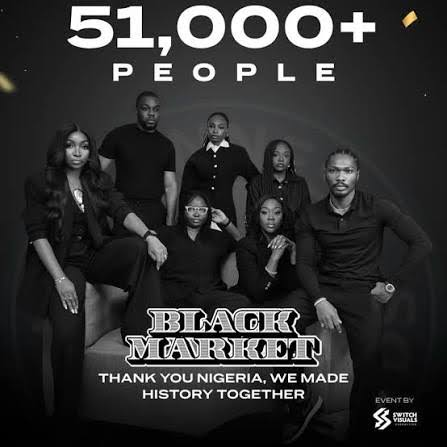


For years, Nollywood premieres have followed a familiar script. Guests arrive, photographers work the red carpet, the cast poses for pictures, the audience watches the film, and everyone goes home. Black Market changed the scale of that formula when its September 26 premiere at Tafawa Balewa Square in Lagos became a Guinness World Records event with 51,000 qualifying viewers. (Channels Television)
The headline is the number, but the more interesting part was how the organisers built the night around the film. The gates opened at 2pm, the red carpet began around 3pm and the main screening followed later in the evening. Music, food, games and entertainment filled the hours around the screening, while the event also involved partners including MTN, Puma, Swoop, PlaystreetNG, Oraimo, Shuttlers and the Lagos State Ministry of Culture. The premiere was structured more like a large live entertainment event than a conventional movie launch. (Channels Television)
That approach makes sense when you look at what the organisers were trying to sell. Black Market was asking people to pay for more than an early look at a film. The official campaign invited audiences to be part of a Guinness World Records attempt, with the event promising prizes, merchandise and transport support. The record attempt became part of the product, because attendees were buying access to a public moment as much as they were buying a film screening. (Black Market Movie)
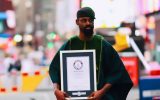
Guinness World Records recognised 51,000 people who stayed from the beginning of the film to the end, even though Lagos State Deputy Governor Obafemi Hamzat said the overall attendance was about 64,000. The previous record was 43,624 people at a 2015 screening of Felix Manalo in the Philippines. Black Market beat that figure while turning the screening into a major social gathering. (NTA – Nigerian Television Authority)
There is a lesson here for Nollywood’s premiere business. Concert promoters have long understood that audiences pay for more than the central performance. The ticket can unlock a wider experience involving fashion, food, brand activations, transport, merchandise, celebrity appearances and the feeling of being present at something everyone will discuss afterwards. Black Market applied some of that thinking to a film premiere, and the Guinness attempt gave every other activity a single reason to exist.
That does not mean every Nollywood film needs 50,000 people at an open-air screening. The economics and logistics would be difficult to reproduce, and the record itself was the hook that made this scale possible. What can travel is the principle that a premiere can be designed as an event with its own value rather than functioning only as a first screening for invited guests and industry insiders.
That shift could also create more room for brands. Black Market’s partner list shows what happens when a film premiere becomes a large audience platform. A telecoms company, sportswear brand or mobility company can attach itself to a physical experience and reach thousands of people in one place. The film gives those brands a cultural context, while their money, services and activations help build the event. (Vanguard News)
There is another commercial lesson in the size of the crowd. A huge audience does not automatically mean every vendor, sponsor or organiser made money. One food vendor said she was left with unsold stock after investing ₦1.5 million for the screening, a reminder that event scale and individual profitability are different things. The experience still needs planning around footfall, vendor placement, transport, security and what attendees are actually willing to buy. (StreetNet)
So, why did watching a Nollywood movie suddenly feel like attending a concert? Black Market turned the screening into a destination, with music, food, games, brands and a world-record attempt giving people reasons to stay before and after the film. Nollywood cannot reproduce that exact model for every release, but it can borrow the thinking behind it. A premiere can sell the film, the occasion and the community around it, creating a bigger commercial event from the same movie.