

Ademola Adeleke’s victory in Osun was barely a few hours old when the governor’s relationship with President Bola Ahmed Tinubu became part of the post-election conversation. In celebrating his return to office, Adeleke thanked Tinubu for what he described as a peaceful contest and again backed the President for a second term in 2027. It was not a new position. Adeleke and the Osun PDP had endorsed Tinubu for 2027 in July 2025, even as Adeleke remained in the PDP and prepared to defend his governorship.
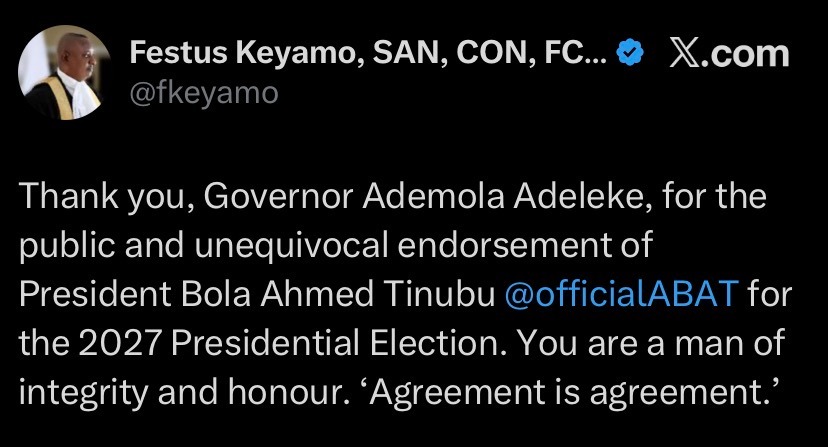
Then Festus Keyamo congratulated Adeleke. The Aviation Minister ended his message with three words: “Agreement is agreement.” And suddenly, the election had a second story.
It is easy to see why the phrase caught attention. Adeleke had just defeated the candidate of Tinubu’s APC in Osun, yet he was also publicly supporting Tinubu’s return to Aso Rock. Before the election, APC leaders had repeatedly insisted that Tinubu’s support in Osun was for Bola Oyebamiji, not Adeleke. Now that Adeleke had won, Keyamo’s choice of words invited a very obvious question: what exactly was the agreement he was referring to?
There is no publicly established evidence that the Federal Government made a secret bargain with Adeleke in exchange for his victory, and Keyamo’s phrase on its own does not establish one. What is already on record is that Adeleke’s support for Tinubu has been deliberate and repeated. When the Osun PDP endorsed the President in 2025, the party explained its decision partly through Tinubu’s identity as a son of Osun and the political interests of the state. Adeleke later described Tinubu as the South-West’s leader and said his support was in the interest of the region.
That makes the political relationship easier to understand without necessarily explaining Keyamo’s comment. Adeleke has made the argument himself: Osun benefits from having a good working relationship with the Federal Government. He has pointed to federal road projects in the state and thanked Tinubu for approving reconstruction work on roads connecting Osun to other parts of the South-West. He has also said that backing Tinubu should be understood beyond party politics.
But there is something unusual about the arrangement. Adeleke ran for re-election outside the APC and defeated its candidate, while simultaneously maintaining that Tinubu should win another presidential term. The APC, meanwhile, campaigned against Adeleke and publicly rejected suggestions that the President had endorsed him. The two sides could disagree bitterly over who should govern Osun and still appear to share an interest in who should govern Nigeria in 2027.
That is not necessarily a contradiction in Nigerian politics. Governors routinely separate the politics of their state from their calculations about the presidency, especially when the interests of a state government and the Federal Government overlap. What makes Adeleke’s case particularly visible is that he has been unusually open about the relationship. He did not quietly support Tinubu; he had the state PDP formally endorse him, defended the decision when questions about defection surfaced, and repeated the endorsement during his governorship campaign.
So what did Keyamo mean?
It could refer to nothing more complicated than Adeleke keeping a publicly stated political commitment. It could be a way of congratulating the governor while reminding observers that the relationship between both camps had not disappeared simply because their parties had competed against each other. It could also have meant something known only to the people involved. The public record does not allow us to choose between those explanations.
That uncertainty is what makes the phrase worth examining. Nigerian politics is full of alliances that are easier to understand after the fact than while they are happening. A politician can campaign against one party at the state level while building a relationship with its presidential candidate; an endorsement can be presented as a matter of principle while also having obvious strategic value. In Osun, Adeleke himself has framed his Tinubu support around development and the state’s relationship with the centre.
There is also the matter of what happens after an endorsement. Adeleke has won another term, while Tinubu is already positioning for 2027. Their interests now overlap in a way that may become more important over the next year. Adeleke has four more years in Osun; Tinubu will be seeking support across the South-West. Neither fact proves an agreement, but both make the relationship politically relevant.
Perhaps the more interesting question is why Keyamo’s three words immediately invite speculation. Politicians make private arrangements all the time, but elections are supposed to produce public mandates. When a minister responds to an opposition governor’s victory by talking about an “agreement”, Nigerians are naturally going to wonder whether they are hearing about a political understanding that existed outside the ballot paper.
For now, the responsible answer is that we do not know. Adeleke’s support for Tinubu is public and well documented. The relationship between the two political camps is real. What “agreement” refers to is not.
And until Keyamo explains what he meant, the three words remain exactly that: three words, carrying much more political weight than their author has publicly explained.