

The first trailer for Children of Blood and Bone was always going to do one thing: get people talking. It is the first major Hollywood adaptation of a fantasy novel that wears Yoruba mythology so proudly on its sleeve, and for many Nigerians, it feels like a cultural milestone years in the making. But as the excitement settled, another conversation quietly took its place. It wasn’t about the visual effects or the scale of the production. It was about who we saw, and perhaps more importantly, who we didn’t.
It is an uncomfortable question, but one worth asking. When Hollywood decides that a Nigerian-inspired story is finally worth spending hundreds of millions of dollars on, why does Nollywood still feel like a guest at its own table?
To be fair, Children of Blood and Bone was never intended to be a documentary on Yoruba history or religion. Orïsha is a fictional kingdom, and Tomi Adeyemi drew inspiration from Yoruba cosmology while building a fantasy world of her own. That creative licence has, however, been one of the novel’s longest-running points of contention. While many readers celebrated its attempt to place African mythology at the centre of an epic fantasy, others, particularly Yoruba readers and cultural critics, argued that the book borrowed heavily from the culture without always capturing it accurately. Names, spiritual concepts and traditions were often reimagined or simplified in ways that some felt detached them from their original meaning. It is a fair criticism, but perhaps also an inevitable one. Fantasy gives writers room to reinvent cultures; the question is whether that reinvention still carries a responsibility to honour the foundations it is built upon. That conversation did not end with the novel. If anything, the film adaptation has reignited it in an entirely new way. It is precisely because the story remains so closely associated with Yoruba cosmology, despite its creative liberties, that many Nigerians instinctively searched the cast list for names they already knew.
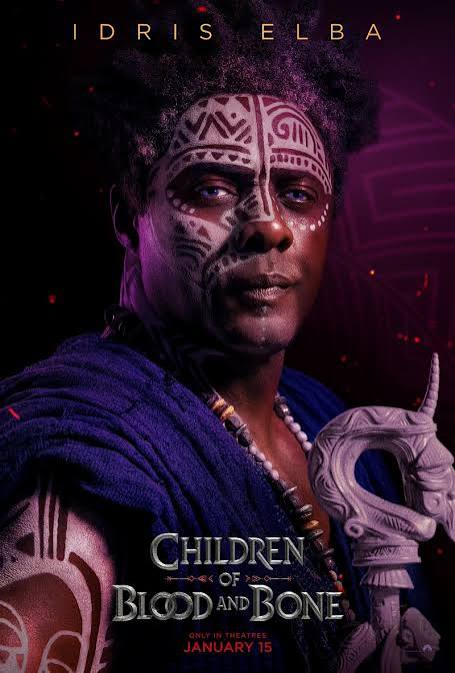
Instead, they found a cast filled with some of the biggest Black stars working in Hollywood today. Viola Davis. Idris Elba. Chiwetel Ejiofor. Cynthia Erivo. Damson Idris. Thuso Mbedu. There is no denying the talent assembled for this film. The question is whether talent was ever the issue. For many viewers, it was about representation in a story that feels so deeply connected to home.
The easy response is to accuse Hollywood of overlooking Nollywood. The harder, and perhaps more honest, question is whether this was ever a decision about culture in the first place. Blockbuster filmmaking has always been driven by risk. Studios spend extraordinary amounts on fantasy franchises, and with those budgets comes pressure to cast actors whose names already carry global commercial weight. Hollywood knows how to measure the box office history of its biggest stars. It does not yet extend that same confidence to actors whose careers have been built primarily within African film industries.
That does not necessarily make the decision right. But it does explain why so many African stories continue to be filtered through actors who have already found success in Western entertainment systems before Hollywood is willing to trust them with stories rooted on the continent.
Even then, casting is only part of the conversation. If representation begins and ends with who appears on the poster, then we are asking the wrong question. Who shaped the screenplay? Who advised on the mythology? Who worked on the language, the costumes and the cultural details that make Orïsha feel lived in rather than imagined from a distance? Those creative decisions often matter just as much as the faces audiences recognise.
The trailer has also reignited another debate that has followed African stories in Hollywood for years: accents. Some viewers have questioned why the dialogue leans towards a broad, familiar “African” sound rather than something more recognisably Nigerian. It is a criticism that reflects changing audience expectations. Around the world, films increasingly trust viewers to embrace regional identities without smoothing them out for international comfort. Should African stories be expected to do the same?
Then there is the conversation about colourism, one that began long before the trailer ever arrived. Some readers of Adeyemi’s novel criticised the casting of lighter-skinned actresses in leading roles, arguing that the protagonists they imagined while reading the book looked different from the women eventually cast on screen. Whether one agrees with that criticism or not, it revealed just how personally many readers connected with the world Adeyemi created, and how carefully they expected that world to be translated to film.
Adeyemi herself has added another layer to the conversation. Despite receiving a co-screenwriting credit, the author has publicly said she will not be promoting or attending the film’s premiere. She has not linked that decision to the casting or the cultural interpretation of the adaptation, and it would be unfair to suggest otherwise. Still, her public distance from the finished project inevitably raises broader questions about what happens when deeply personal stories become studio productions. How much influence does an author really retain once Hollywood takes over?
Perhaps that is the question sitting beneath every other debate surrounding Children of Blood and Bone. This is not simply about whether more Nollywood actors should have been cast. It is about what authenticity looks like when African stories enter global entertainment. Is it enough for a story to be inspired by Nigeria if the people shaping it are largely outside Nigeria? Can a film faithfully celebrate Yoruba mythology while leaving many Nigerians feeling like spectators rather than participants?
None of these questions diminishes what this film represents. Seeing a world inspired by Yoruba cosmology transformed into a major Hollywood fantasy is an achievement that would have seemed almost impossible a decade ago. It signals that African stories are no longer considered too niche for global audiences. That, in itself, is progress.
But progress has a way of creating new expectations. If Hollywood now believes Nigerian stories deserve billion-dollar ambition, then perhaps the next conversation is not whether those stories should be told at all. It is whether the people who have carried those stories for generations will finally be trusted to tell them from the centre, rather than from the edges.