


Harvard Kennedy School’s Center for International Development (CID) will host its 17th annual Global Empowerment Meeting (GEM26) on May 4-5, 2026, convening leading global thinkers and practitioners to tackle one of the most pressing questions of our time: how to reimagine international development amid shifting geopolitics, constrained resources, and evolving power dynamics.
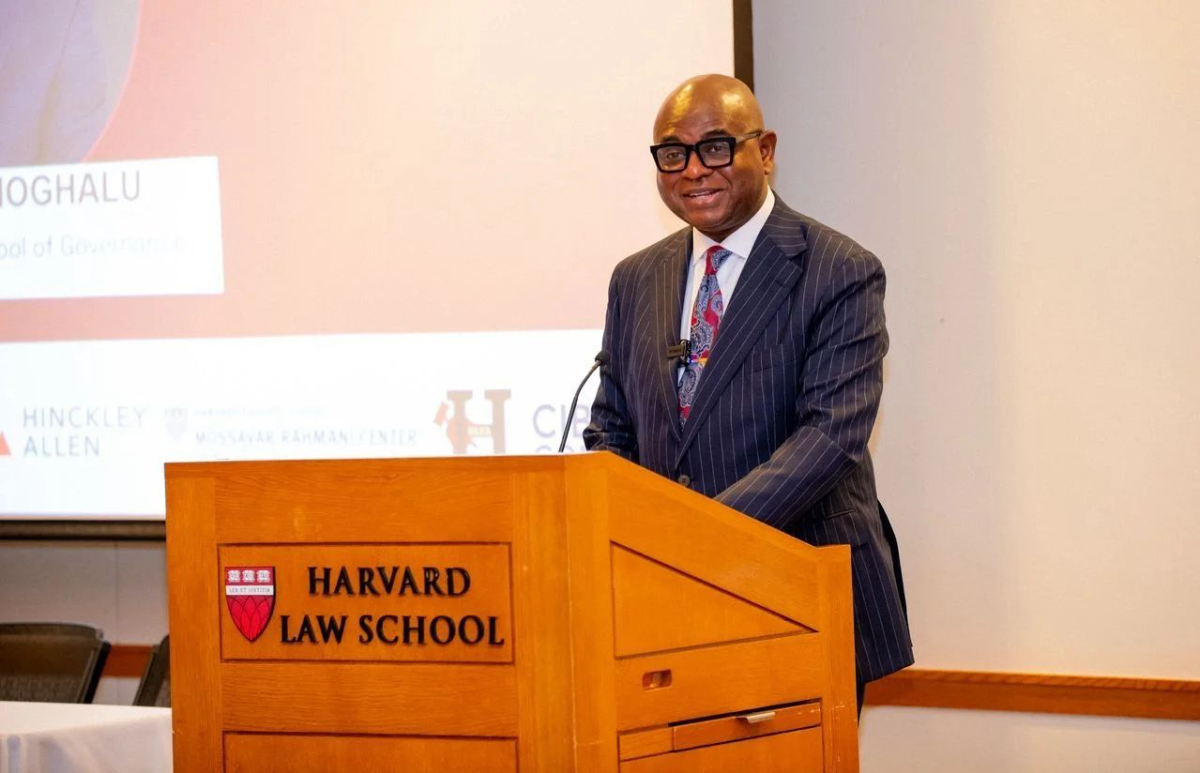
Among the distinguished speakers is Kingsley Moghalu, renowned political economist, former Deputy Governor of the Central Bank of Nigeria, and a leader in advancing economic governance, institutional capacity, and policy innovation across Africa. Moghalu is the Founder and President of IGET Academy, a public policy think-tank and executive education academy for African leaders headquartered in Abuja and Washington DC. He will participate as a panelist on Panel 2: “Doing Development Differently” on Tuesday, May 5, from 1:30 – 3:00 p.m. US Eastern Time.
The panel forms part of GEM26’s core focus on Reimagining International Development, which explores fresh strategies for growth, equity, sustainability, and cooperation in a world of aid cuts, volatile markets, and geoeconomic fragmentation. Discussions are expected to generate actionable insights into policy action.
CID Faculty Director Asim Ijaz Khwaja and Executive Director Fatema Z. Sumar highlighted Moghalu’s contributions in their invitation: “Your leadership in advancing economic governance, institutional capacity, and policy innovation across Africa—including through your work in central banking, international policy, and leadership development—has helped shape important conversations about Africa’s role in the global economy. Your perspective would bring valuable insight to this conversation on how development must evolve to meet the challenges of our time.”
Moghalu expressed gratitude for the invitation and the opportunity to contribute: “This is a discussion with potential outcomes that could reshape the trajectory of many developing countries, especially in Africa. I am honored to join this gathering and look forward to robust exchanges on practical, context-aware approaches to development.”
GEM26 features an extraordinary lineup of scholars, Nobel laureates, and global leaders. Other speakers include Jeremy Weinstein, Dean of the Harvard Kennedy School, Dani Rodrik, Ford Foundation Professor of International Political Economy at Harvard Kennedy School, James Robinson, co-winner of the Nobel Prize for Economics (2024) and University Professor at the Harris School of Public Policy at the University of Chicago, Esther Duflo, co-winner of the Nobel Prize for Economics (2019) and the Abdul Lateef Jameel Professor of Development Economics at the Massachusetts Institute of Technology (MIT), and Raghuram Rajan, the Katherine Dusak Miller Distinguished Service Professor of Finance at the University of Chicago’s Booth School of Business and former Governor of the Reserve Bank of India. Other speakers include Samantha Power, Anna Lindh Professor of the Practice of Global Leadership at the Harvard Kennedy School and former Administrator of the United States Agency for International Development (USAID), Yuen Yuen Ang, the Alfred Chandler Professor of Political Economy at Johns Hopkins University and author of How China Escaped the Poverty Trap, Khalil Shariff, CEO of the Aga Khan Foundation, and Rachel Glennerster, CEO of the Center for Global Development.
GEM26 builds on CID’s tradition of fostering evidence-informed dialogue that translates ideas into impact. The meeting—some of which will be live-streamed—is aimed at challenging assumptions and incubating scalable solutions for a more resilient global development landscape.
Moghalu’s participation underscores the growing recognition of African-led perspectives in reshaping global thinking about development. His expertise, drawn from high-level policy experience as a former senior official of the United Nations, CBN Deputy Governor, Professor of Practice in International Business and Public Policy at Tufts University’s Fletcher School of Law and Diplomacy, and institution-building efforts including as the inaugural President and Vice-Chancellor of the African School of Governance, is expected to enrich conversations on moving beyond traditional models toward approaches that prioritize local agency, institutional strength, and sustainable outcomes.
Virtual attendance for parts of the program is open via registration on the Harvard Kennedy School website: https://www.hks.harvard.edu/gem/about/agenda
Media Inquiries: info@igetafrica.org