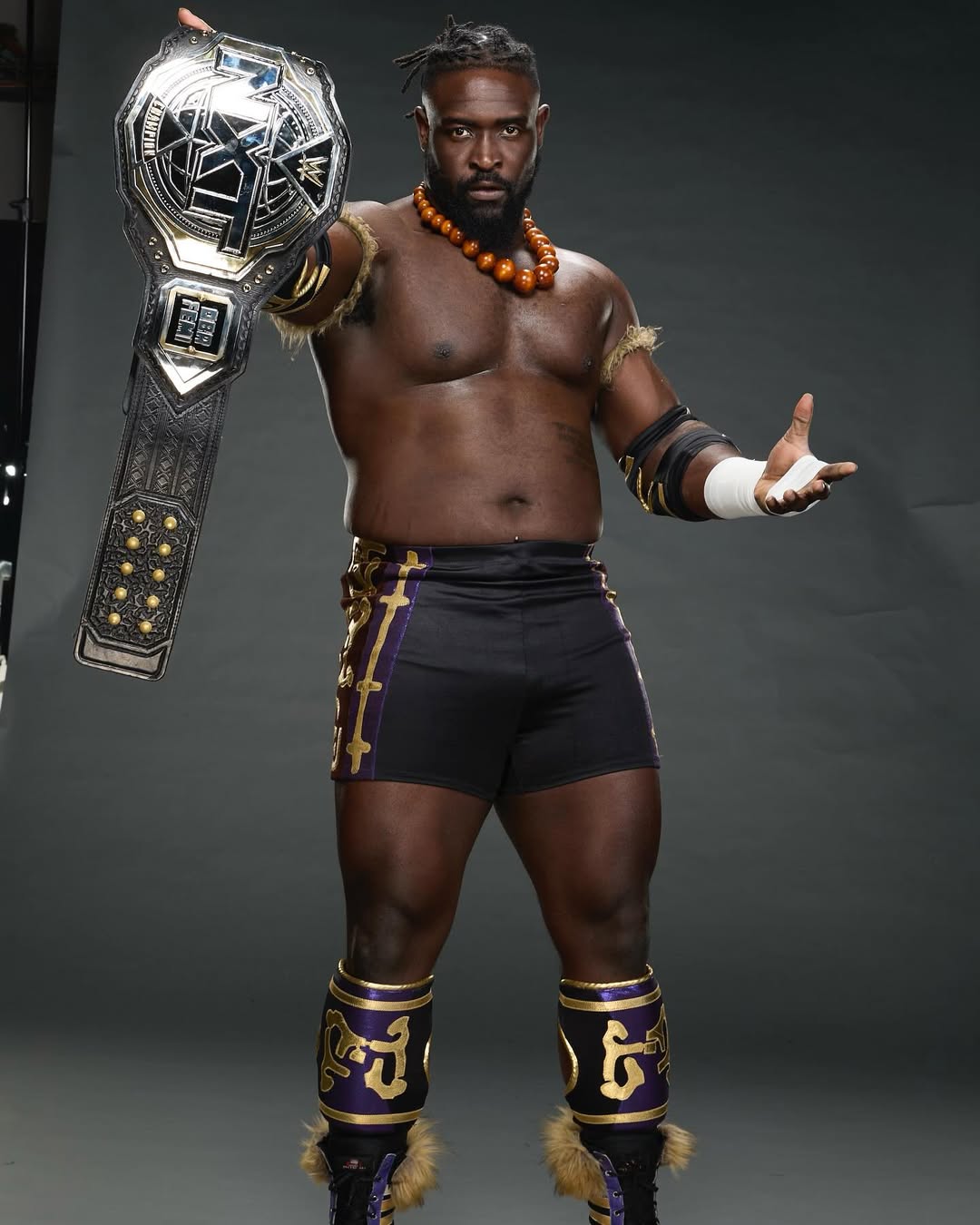


Two Sundays ago at Allegiant Stadium in Las Vegas, a Lagos-born former shot putter powerbombed Brock Lesnar into retirement in under five minutes. Oba Femi, born Isaac Odugbesan, opened WrestleMania 42 Night 2 by no-selling the F-5, countering with a chokeslam, and finishing Lesnar with a Fall from Grace for a clean pinfall. When it was done, Lesnar took off his gloves and boots, hugged Paul Heyman, and left them in the ring. In wrestling language, that is a retirement.
Femi didn’t wait for the crowd to catch its breath. He grabbed the mic and called out Roman Reigns, WWE’s biggest current draw, telling the fans Reigns could “get some” before the year ends.
There’s a playbook running underneath that moment, and WWE didn’t invent it. The UFC has been running it for six years. Kamaru Usman held the welterweight title for more than three and a half years. Israel Adesanya ran the middleweight division twice. Between 2019 and 2023, a UFC main event with a Nigerian in it was a guaranteed social-media event in Lagos, Abuja, and every estate in between. The UFC didn’t run a single card in Nigeria during that entire stretch. It didn’t need to. The fandom did the work for free.
That window is closing. Adesanya has lost four fights in a row, most recently by TKO at UFC Seattle in March. Usman hasn’t held a belt since 2022 and spent four years between wins. The UFC’s Nigerian wave is in its sunset. Right on cue, a different American sports-entertainment company has a Nigerian heavyweight going viral on Nigerian X.
Femi’s arrival at WWE wasn’t accidental either. The company signed him in 2021 through its Next In Line programme, a scouting pipeline built to convert American college athletes into wrestlers. He was at Alabama on a shot put scholarship after transferring from Middle Tennessee State. He got the tryout after WWE’s recruitment team sent him an Instagram DM. He had never wrestled a day in his life. Six-foot-six, over three hundred pounds, freshly graduated with a visual arts degree, ready for the machine.
Within three years of signing, he was the longest-reigning NXT North American Champion in the title’s history. Within five, he was winning at WrestleMania. CNN’s Larry Madowo sat him down at WWE headquarters four days before the Lesnar match and got the interview published globally. WWE signed off on that. The company knows what it has.
Whether Femi becomes a main-event star is already settled business. The more useful question for the Nigerian audience is whether WWE will ever bring a Premium Live Event to the continent making Femi marketable in the first place. Every other serious market has hosted one. Saudi Arabia gets two a year. The UK has had stadium shows at Wembley and Principality. Australia, Germany, France and Puerto Rico are all on the map. Africa has never hosted a PLE.
Femi said in 2024 that he wanted to change that, and that he knew he had to earn the credibility before pushing Triple H on it. That credibility arrived on Sunday.
The Afrobeats playbook keeps writing itself. Burna Boy headlined Madison Square Garden before he ever headlined a purpose-built arena in Lagos, because Lagos doesn’t have one. Wizkid’s “Essence” only cracked the US top ten after Justin Bieber jumped on the remix. African cultural and athletic output gets extracted, polished abroad and sold back to the diaspora and the home audience through foreign platforms. Nigerian fans tune in and global companies see the numbers. The infrastructure side of the ledger stays empty.
Oba Femi is twenty-seven. His peak is ahead of him. If WWE runs the script the industry has perfected, he’ll hold a title, sell merchandise, draw millions of Nigerian streams, and work stadium shows in Riyadh, London and New Jersey. The company will tell itself it’s serving the African market by putting a Nigerian on global TV.
WWE has its Nigerian main-eventer. What Nigeria gets from them remains an open question.